Satisfaction
Guaranteed

All products are handled with strict quality standards to ensure consistent research-grade excellence.

Secure
Ordering

Our checkout is SSL encrypted and completely secure.

Third-party
Tested

Our products are verified by independent third party laboratories to meet quality standards.

Batch & Lot
Tracking

All product batches and lots are assigned unique identifiers and tied to publicly posted lab reports.

Endless
Commitment

We are committed to helping our customers. If you have any questions or concerns, please reach out through our Contact Us page.

NAD+

$69.99

Save 5.01$ (7% Off)

Purchase & earn 70 points!

Discount per Quantity

QuantityDiscountPrice
5 - 105%$66.49
11 - 2010%$62.99
21+15%$59.49

Rigorous Third-Party Testing

Every batch of our research chemicals and peptides undergoes
third-party testing.

*Disclaimer: This product is intended solely for laboratory research purposes. It is not suitable for consumption by humans, nor for medical, veterinary, or household purposes. Kindly review our Terms & Conditions before making a purchase.

Always quality-tested, verified with third party COA’s


At every step, we prioritize quality by conducting rigorous third-party testing on all our products. These tests focus on five key characteristics- identity, purity, sterility, and endotoxin levels, and heavy metal content-ensuring that each product meets the highest standards of quality with independent third-party Certificates of Analysis (COAS) to verify our commitment to excellence.

Identity Test

Identity testing ensures that the product contains the correct ingredient as labeled, verifying its authenticity and matching it to established reference standards.

Purity Test

Purity and concentration testing verifies that the ingredient is present in the correct amount, with a purity of 99% or higher to meet stringent quality standards.

Sterility Test

Sterility testing ensures that the product is completely free from bacteria, fungi, and other microorganisms.

Endotoxin Test

Endotoxicity testing specifically detects and quantifies lipopolysaccharides (LPS), components of bacterial cell walls, to ensure the product is free from endotoxins.

Heavy Metals Test

Heavy metals testing ensures that the product is free of heavy metals such as lead, arsenic, mercury, cadmium, and other heavy metals.

Identity Test

Identity testing ensures that the product contains the correct ingredient as labeled, verifying its authenticity and matching it to established reference standards.

Purity Test

Purity and concentration testing verifies that the ingredient is present in the correct amount, with a purity of 99% or higher to meet stringent quality standards.

Sterility Test

Sterility testing ensures that the product is completely free from bacteria, fungi, and other microorganisms.

Endotoxin Test

Endotoxicity testing specifically detects and quantifies lipopolysaccharides (LPS), components of bacterial cell walls, to ensure the product is free from endotoxins.

Heavy Metals Test

Heavy metals testing ensures that the product is free of heavy metals such as lead, arsenic, mercury, cadmium, and other heavy metals.

*Disclaimer: This product is intended solely for laboratory research purposes. It is not suitable for consumption by humans, nor for medical, veterinary, or household purposes.Kindly review our Terms & Conditions before making a purchase.

NAD+ (nicotinamide adenine dinucleotide) is a central redox coenzyme studied for its role in cellular energy metabolism, mitochondrial function, and sirtuin-mediated signaling pathways, which was first characterized in early 20th-century biochemical research. Researchers investigating metabolic regulation and aging-related pathways can buy NAD+ (500mg) from Spark Peptide at 99.9%+ purity, verified via 6x analytical testing by trusted third-party labs to meet strict quality and purity standards, with Certificates of Analysis available. Sold for research use only.

NAD+ Overview

NAD+ (500mg) is a naturally occurring coenzyme found in all living cells. It is essential for energy production and cellular signaling, and researchers looking to buy NAD+ often focus on its role in metabolic regulation and sirtuin-related pathways. NAD+ plays a central role in redox reactions and mitochondrial function, making it a key compound in studies of cellular energy balance. Given the central role it plays in research, Spark Peptide supplies high-purity NAD+ and verifies each batch through HPLC and mass spectrometry testing, with supporting COA documentation. These strict quality and testing protocols support consistent purity for use in metabolic pathway research, signaling studies, and laboratory models of cellular regulation.

Molecular Origin

NAD+ (nicotinamide adenine dinucleotide) is not a peptide but a small, naturally occurring dinucleotide coenzyme composed of two nucleotides joined through their phosphate groups. One nucleotide contains an adenine base, while the other includes nicotinamide, a derivative of vitamin B3. It functions within fundamental metabolic pathways, particularly in redox reactions central to cellular respiration and energy production. First identified in the early 1900s during studies of fermentation and cellular metabolism, NAD+ was characterized through the work of researchers such as Arthur Harden and William Young [1]. Structurally, NAD+ cycles between oxidized (NAD+) and reduced (NADH) forms, enabling electron transfer in biochemical reactions. For research applications, NAD+ is synthesized through controlled chemical processes that ensure high purity and structural fidelity. Its defined molecular structure and role as a cofactor in enzymatic systems make it highly relevant for investigating metabolic flux, mitochondrial activity, and signaling pathways such as sirtuin and PARP-mediated processes.

Purity & Quality Standards

Spark Peptide offers NAD+ (500mg) for sale produced to 99.9%+ purity standards as verified through HPLC analysis, ensuring consistent analytical performance across batches. This is possible because our manufacturing follows cGMP-certified processes aligned with ISO 9001:2015 quality management standards, supporting reproducibility and traceability. Each batch also undergoes Spark Peptide’s 6X Safety Testing protocol, including HPLC purity confirmation, mass spectrometry identity verification, heavy metal screening, endotoxin testing, bacterial contamination analysis, as well as solubility and stability assessment. Certificates of Analysis are provided for every batch to document these results.  For shipping and storage, protective packaging is used to limit temperature fluctuations during transit, preserving compound stability under typical shipping conditions. You can find more accurate technical details for each batch on the Spark Peptide Tests & Safety page, including molecular information, testing dates, purity results, and more.

NAD+ Mechanism of Action

NAD+ operates through enzyme-mediated mechanisms rather than traditional receptor-driven signaling, making its activity highly dependent on intracellular availability and metabolic context. Its role spans redox balance, substrate provision for signaling enzymes, and regulation of cellular energy state.

Receptor Binding & Primary Signaling

NAD+ does not function as a ligand for a classical cell-surface receptor; instead, it is an essential intracellular coenzyme and substrate within multiple enzyme systems. Its primary mechanistic role is defined by participation in redox reactions, where it cycles between oxidized (NAD+) and reduced (NADH) states to facilitate electron transfer in metabolic pathways such as glycolysis, the tricarboxylic acid cycle, and oxidative phosphorylation [2] Beyond redox activity, NAD+ also serves as a substrate for several enzyme classes, including sirtuins (NAD+-dependent deacetylases), poly(ADP-ribose) polymerases (PARPs), and CD38/CD157 ectoenzymes [3]. In these contexts, NAD+ binding occurs at conserved catalytic domains rather than receptor-binding pockets. For example, sirtuins exhibit Km values for NAD+ typically in the low to mid micromolar range, reflecting physiologically relevant sensitivity to intracellular NAD+ concentrations [4]. Upon binding, NAD+ undergoes cleavage, generating nicotinamide and ADP-ribosyl intermediates that drive downstream enzymatic reactions. This substrate-dependent mechanism positions NAD+ as a central regulator of cellular signaling through enzyme-mediated pathways rather than receptor-initiated signaling events [3].

Downstream Biological Cascades

Through its role as a substrate for NAD+-dependent enzymes, NAD+ influences several interconnected intracellular signaling pathways. Sirtuin activation, driven by NAD+ availability, regulates protein deacetylation across targets involved in mitochondrial biogenesis, oxidative metabolism, and stress response pathways, including modulation of PGC-1α and FOXO transcription factors [2]. In parallel, PARP enzymes utilize NAD+ to facilitate ADP-ribosylation reactions involved in DNA repair and genomic stability, linking NAD+ levels to cellular responses to DNA damage [5]. NAD+ metabolism also intersects with calcium signaling through CD38-mediated production of cyclic ADP-ribose, a secondary messenger involved in intracellular Ca²⁺ mobilization [6]. These pathways have been extensively characterized in in vitro systems and animal models, where alterations in NAD+ availability influence metabolic flux, mitochondrial function, and transcriptional regulation. Collectively, these mechanisms position NAD+ as a central integrator of metabolic signaling networks, coordinating energy status with gene expression, enzymatic activity, and cellular stress responses across multiple biological systems.

Key Scientific Features & Chemical Profile of NAD+

The following molecular data outlines core chemical identifiers and physicochemical characteristics of NAD+ (nicotinamide adenine dinucleotide), to support accurate compound verification, handling, and reproducibility in laboratory research settings.

NAD+ Molecular Data

 
Property Detail
Name NAD+ (Nicotinamide Adenine Dinucleotide, oxidized form)
Classification Naturally occurring dinucleotide coenzyme; non-protein small molecule
Molecular Formula C21H27N7O14P2
Molecular Weight 663.43 Da (oxidized form; minor variation may occur depending on counterion or formulation)
Structural Class Dinucleotide composed of adenine and nicotinamide nucleotides linked by a pyrophosphate bridge
Structural Note NAD+ is not a peptide and does not consist of an amino acid sequence; it is derived from niacin (Vitamin B3) and present in all living cells
Functional Forms Oxidized form (NAD+) and reduced form (NADH); cycles between both states as a central electron carrier
Primary Signaling Targets Sirtuins (SIRT1–SIRT7); PARP enzymes; CD38/CD157; oxidoreductase enzymes in glycolysis, TCA cycle, and oxidative phosphorylation
CAS Number 53-84-9
PubChem CID 5892
Format Lyophilized powder supplied in sterile glass research vials
Purity ≥99.9%, verified by HPLC and lot-specific Certificate of Analysis (COA)
Solubility Highly soluble in sterile water and aqueous laboratory buffers
Hygroscopicity Highly hygroscopic; must be protected from moisture and humidity at all times
Storage (Lyophilized) 2–8°C (36–46°F) for routine use; –20°C (–4°F) for long-term storage; protect from light and moisture
Storage (Reconstituted) 2–8°C (36–46°F) for short-term use; aliquot to avoid repeated freeze–thaw cycles; limited stability in solution
Stability Stable in lyophilized form under cold, dry, light-protected conditions; degradation accelerates in aqueous solution, heat, or light exposure
Handling Notes Prepare under aseptic conditions; minimize exposure to air, light, and humidity; use promptly after reconstitution
Batch EP-250501-ND500
Research Designation For research use only — not approved for human or veterinary use, clinical administration, or therapeutic application
Supplier Spark Peptide
 

Analytical Verification

Each batch of NAD+ supplied by Spark Peptide is accompanied by a Certificate of Analysis (COA) generated through independent third-party laboratory testing, providing verified data on identity, purity, and safety parameters. Purity is assessed using high-performance liquid chromatography (HPLC), where the compound is separated and quantified to confirm ≥99.9% purity. Molecular identity is confirmed through mass spectrometry (MS), with observed mass spectra matched against the theoretical molecular mass of NAD+. To ensure consistency across research applications, Spark Peptide applies a proprietary 6X Safety Testing protocol, incorporating multiple layers of analytical validation:
  • HPLC purity analysis: confirms compositional integrity and detects trace impurities
  • Mass spectrometry (MS): verifies molecular identity and structural accuracy
  • Heavy metals screening: identifies trace elemental contaminants
  • Endotoxin testing: detects pyrogenic substances that may affect in vitro systems
  • Bacterial contamination analysis: ensures microbial quality and sample integrity
  • Solubility and stability testing: confirms predictable handling and storage behavior under standard laboratory conditions
Together, these analytical methods provide a comprehensive dataset for each batch, supporting reproducibility in metabolic assays, enzymatic studies, and controlled investigations involving NAD+-dependent biochemical pathways.

Storage, Handling, and Reconstitution

Proper storage, handling, and reconstitution practices are critical for maintaining the chemical integrity of NAD+ throughout its use in laboratory settings. Due to its sensitivity to moisture, temperature, and light, particularly in solution, careful control of environmental conditions helps minimize degradation and variability.  The following guidelines outline standard procedures to support stability, consistency, and reproducibility across experimental applications.

Recommended Storage Conditions

NAD+ (500mg) is chemically stable in lyophilized form but remains sensitive to moisture, heat, and light due to its hygroscopic nature and susceptibility to hydrolysis in solution. Proper storage conditions are essential to preserve structural integrity and prevent degradation into nicotinamide and related byproducts. Environmental exposure—particularly humidity and elevated temperatures—can accelerate loss of activity, even in solid form.
  • Store lyophilized NAD+ at -4°F (-20°C) for long-term preservation
  • Short-term storage at 36–46°F (2–8°C) is acceptable under controlled, low-humidity conditions
  • Keep vials tightly sealed and stored with desiccant to limit moisture exposure
  • Protect from direct light, particularly UV, to reduce degradation risk
  • Maintain in original airtight container to avoid atmospheric exposure
When handled under these conditions, lyophilized NAD+ remains stable for extended periods. Once reconstituted, however, stability decreases significantly due to increased susceptibility to hydrolysis and oxidation.
  • Store reconstituted solutions at 36–46°F (2–8°C)
  • Avoid prolonged storage in aqueous form; prepare only the volume required for short-term use
  • Minimize light exposure and repeated temperature fluctuations after reconstitution

Reconstitution Protocol

Reconstitution of NAD+ should be performed using controlled laboratory techniques to preserve chemical stability and ensure consistency across experimental applications. As a small, water-soluble coenzyme, NAD+ dissolves readily; however, improper handling - such as rapid agitation or exposure to heat - can accelerate degradation.
  1. Allow the vial to reach room temperature before opening to prevent condensation inside the vial
  2. Using aseptic technique, introduce bacteriostatic water (e.g., Spark Peptide’s Bacteriostatic Water 10ml) or sterile laboratory-grade buffer as the solvent
  3. Add the solvent slowly along the inner wall of the vial to reduce localized concentration gradients
  4. Avoid vortexing or vigorous shaking, as mechanical stress may contribute to degradation
  5. Gently swirl or invert the vial until the powder is fully dissolved
  6. Typical reconstitution volumes range from 1–5 mL, depending on experimental concentration requirements
  7. Confirm that the solution is clear and free of visible particulates before use
Following reconstitution, NAD+ solutions should be handled with care to maintain integrity.
  • Store the solution at 36–46°F (2–8°C) immediately after preparation
  • Use within a short timeframe, as NAD+ in solution gradually degrades, especially with light or heat exposure
  • Avoid repeated freeze–thaw cycles, which can accelerate chemical breakdown

Handling Precautions

Due to its sensitivity to environmental conditions, NAD+ requires careful handling throughout preparation and experimental use. Standard laboratory practices should be followed to minimize contamination, degradation, and variability in experimental outcomes.
  • Handle in a clean or sterile laboratory environment using appropriate aseptic technique
  • Minimize exposure to ambient air and humidity during handling and preparation
  • Avoid repeated freeze–thaw cycles to preserve molecular stability
  • Use appropriate personal protective equipment (PPE), including gloves and lab coats
  • Follow established laboratory protocols for documentation, labeling, and sample tracking
  • For research use only - not approved for human or veterinary use, clinical administration, or therapeutic application
Maintaining strict control over handling conditions supports reproducibility and ensures that NAD+ performs consistently across biochemical and cellular research applications.

NAD+ Research & Scientific Applications

NAD+ is widely studied as a central metabolic cofactor and signaling substrate, with research spanning energy metabolism, enzymatic regulation, and cellular stress responses. Preclinical data suggest that intracellular NAD+ availability directly influences multiple biochemical pathways, making it a key variable in experimental models examining mitochondrial function, redox balance, and NAD+-dependent enzyme activity.

Preclinical & Diagnostic Research

In laboratory settings, NAD+ is primarily investigated through in vitro systems that model cellular metabolism and enzyme-driven signaling. Cell culture studies frequently assess NAD+-dependent processes such as redox cycling, ATP production, and mitochondrial respiration, often using metabolic flux assays and oxygen consumption measurements as key endpoints [3]. In-vitro studies have demonstrated that NAD+ availability regulates sirtuin activity, with downstream effects on transcriptional control of metabolic genes, including those involved in oxidative phosphorylation and mitochondrial biogenesis [2]. NAD+ also plays a critical role in PARP-mediated DNA repair pathways, where its depletion or supplementation alters ADP-ribosylation activity and genomic stability markers. Published findings indicate that NAD+ levels can modulate PARP activity in response to induced DNA damage, providing a measurable link between cellular energy status and repair mechanisms [5][7] Additionally, CD38-dependent NAD+ metabolism is frequently studied in calcium signaling assays, where cyclic ADP-ribose production is quantified as a secondary messenger influencing intracellular Ca²⁺ release [3]. These experimental systems support the use of NAD+ in biochemical assays, enzyme kinetics studies, and investigations into metabolic signaling networks, where endpoints include enzyme activity, transcriptional responses, and intracellular metabolite levels.

Animal Model Observations

Animal studies have provided further insight into how NAD+ availability influences systemic metabolic and signaling processes. Rodent models have demonstrated that alterations in NAD+ levels are associated with measurable changes in mitochondrial function, including increased oxidative capacity and shifts in energy substrate utilization. Experimental findings suggest that NAD+-dependent activation of sirtuin pathways correlates with changes in gene expression linked to mitochondrial biogenesis and oxidative metabolism [2][8]. In murine studies, NAD+ metabolism has also been examined in the context of cellular stress and DNA repair, where PARP activation and NAD+ consumption are quantified following induced genomic damage. These models consistently show that NAD+ depletion is associated with reduced cellular energy availability and altered metabolic signaling markers. Additionally, CD38 knockout models have been used to study NAD+ turnover, with reported increases in intracellular NAD+ levels and corresponding changes in calcium signaling dynamics [5]. Quantitative measurements across these studies include shifts in NAD+/NADH ratios, enzyme activity levels, mitochondrial respiration rates, and transcriptional markers of metabolic regulation. Collectively, these findings position NAD+ as a central variable in experimental models investigating the integration of metabolic state, enzyme signaling, and cellular homeostasis.

NAD+ Comparative Analysis: NAD+ vs NMN vs Semaglutide

NAD+ differs fundamentally from receptor-active peptides in that it functions as an intracellular coenzyme rather than a signaling ligand. It is most directly comparable to nicotinamide mononucleotide (NMN), a key intermediate in the NAD+ salvage pathway, and more broadly contrasted with GLP-1 receptor agonists. Comparative studies indicate that NMN requires enzymatic conversion via NMNAT to form NAD+, whereas NAD+ itself directly participates in redox reactions and serves as a substrate for sirtuins, PARPs, and CD38 [1]. In contrast, GLP-1 analogs act at the cell surface by binding G protein–coupled receptors, initiating cAMP-mediated signaling cascades that regulate metabolic pathways indirectly. Structurally, NAD+ is a dinucleotide with limited membrane permeability, often requiring transport or extracellular conversion in experimental systems. NMN, being smaller, demonstrates more efficient cellular uptake in certain models, influencing intracellular NAD+ pools. GLP-1 peptides, by comparison, are engineered for receptor selectivity and stability, with modifications that extend persistence in biological systems. These distinctions define their use across research contexts, from direct enzymatic assays (NAD+) to precursor metabolism studies (NMN) and receptor signaling investigations (GLP-1 analogs).  
Parameter NAD+ Nicotinamide Mononucleotide (NMN) GLP-1 Analog
Half-life Rapid intracellular turnover; consumed in enzymatic reactions Converted to NAD+ via NMNAT pathway Extended stability via peptide modification
Receptor Selectivity No receptor binding; enzyme substrate (sirtuins, PARPs, CD38) No direct receptor binding GLP-1 receptor (GPCR) selective agonism
Primary Mechanism Redox cofactor and enzymatic substrate NAD+ precursor (salvage pathway intermediate) GPCR activation → cAMP signaling cascade
Research Applications Metabolic flux, enzyme kinetics, redox biology NAD+ biosynthesis and precursor uptake models Receptor signaling, endocrine pathway modeling
  Beyond these comparisons, other peptide-based compounds are frequently explored in metabolic research, including Tirzepatide and Ipamorelin. These molecules act through receptor-mediated endocrine pathways, influencing metabolic signaling at the systemic level rather than directly participating in intracellular biochemical reactions. Experimental models suggest that such peptides are best suited for studying hormone-driven regulatory networks, whereas NAD+ remains central to investigations of cellular energy transfer, enzymatic activity, and redox-dependent signaling processes.

Peer-Reviewed Research & Citations

  1. Chini, C. C. S., Tarragó, M. G., & Chini, E. N. (2017). NAD and the aging process: Role in life, death and everything in between. Molecular and Cellular Endocrinology, 455, 62–74. https://doi.org/10.1016/j.mce.2016.11.003
  2. Yusri, K., Jose, S., Vermeulen, K. S., Tan, T. C. M., & Sorrentino, V. (2025). The role of NAD+ metabolism and its modulation of mitochondria in aging and disease. NPJ Metabolic Health and Disease, 3(1), 26. https://doi.org/10.1038/s44324-025-00067-0
  3. Covarrubias, A. J., Perrone, R., Grozio, A., & Verdin, E. (2021). NAD+ metabolism and its roles in cellular processes during ageing. Nature Reviews Molecular Cell Biology, 22(2), 119–141. https://doi.org/10.1038/s41580-020-00313-x
  4. Mouchiroud, L., Houtkooper, R. H., & Auwerx, J. (2013). NAD⁺ metabolism: A therapeutic target for age-related metabolic disease. Critical Reviews in Biochemistry and Molecular Biology, 48(4), 397–408. https://doi.org/10.3109/10409238.2013.789479
  5. Wilk, A., Hayat, F., Cunningham, R., et al. (2020). Extracellular NAD+ enhances PARP-dependent DNA repair capacity independently of CD73 activity. Scientific Reports, 10, 651. https://doi.org/10.1038/s41598-020-57506-9
  6. Yu, P., Cai, X., Liang, Y., Wang, M., & Yang, W. (2020). Roles of NAD+ and its metabolites in regulated calcium channels in cancer. Molecules, 25(20), 4826. https://doi.org/10.3390/molecules25204826
  7. Conlon, N. J. (2022). The role of NAD+ in regenerative medicine. Plastic and Reconstructive Surgery, 150(4 Suppl), 41S–48S. https://doi.org/10.1097/PRS.0000000000009673
  8. Braidy, N., Guillemin, G. J., Mansour, H., Chan-Ling, T., Poljak, A., & Grant, R. (2011). Age-related changes in NAD+ metabolism, oxidative stress, and SIRT1 activity in Wistar rats. PLoS ONE, 6(4), e19194. https://doi.org/10.1371/journal.pone.0019194

Certificate of Analysis & Lab Reports

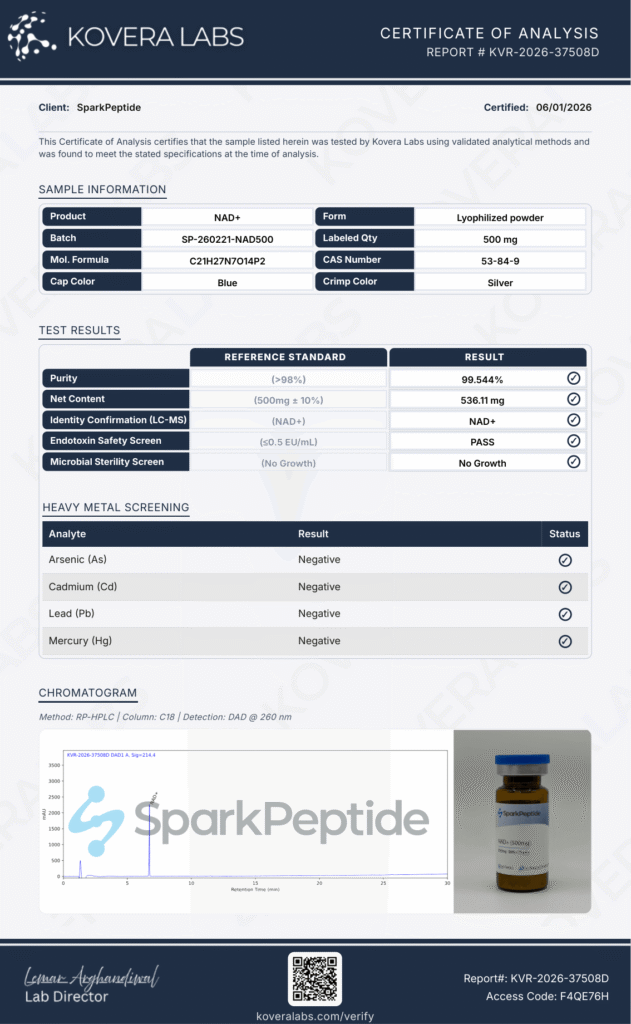
Each batch of NAD+ (500mg) from Spark Peptide is supplied with a Certificate of Analysis (COA) generated through independent third-party laboratory testing. This documentation provides batch-specific verification of compound identity, purity, and safety parameters, supporting traceability and consistency across laboratory research applications. As part of Spark Peptide’s 6X Safety Testing protocol, the COA serves as a primary reference for validating analytical integrity prior to experimental use. The COA includes detailed analytical data for the specific production lot, including purity confirmation via high-performance liquid chromatography (HPLC) and molecular identity verification through mass spectrometry (MS). Additional batch information, such as lot number, testing dates, and analytical methodologies, is provided to enable independent verification and reproducibility in controlled research settings.

HPLC Analysis Report

High-performance liquid chromatography (HPLC) is used to assess the chemical purity of NAD+ by separating individual components based on their interaction with the chromatographic system. This allows for precise quantification of the primary NAD+ peak relative to any detectable impurities or degradation products. This batch: ≥99.9% purity via HPLC

Mass Spectrometry Report

Mass spectrometry (MS) is used to confirm molecular identity by measuring the mass-to-charge ratio (m/z) of ionized NAD+ molecules. The resulting spectral profile is compared against the theoretical molecular mass of NAD+, ensuring structural accuracy and confirming the presence of the intact dinucleotide.

Additional Safety Screening

As part of the 6X Safety Testing protocol, each batch undergoes additional analytical screening to ensure suitability for laboratory use. This includes heavy metals testing for trace elemental contaminants, endotoxin analysis to detect pyrogenic substances, and bacterial contamination screening. Solubility and stability assessments are also performed to confirm predictable handling characteristics under standard laboratory conditions. Complete analytical reports are available upon request or through the Spark Peptide Tests & Safety page, supporting transparency and reproducibility in experimental research environments.

Why 6X Safety Testing Matters for Your Research

While most suppliers verify purity alone, every SparkPeptide batch passes six independent quality and safety screenings before reaching your laboratory.  
# Test What It Confirms
1 HPLC Purity Analysis Peptide purity at 99.9%+ via reverse-phase chromatography
2 Mass Spectrometry Correct molecular identity (observed vs. expected mass)
3 Heavy Metal Screening Below detectable limits for lead, mercury, arsenic, cadmium
4 Endotoxin Testing Bacterial endotoxin levels within safe research thresholds (LAL assay)
5 Bacterial Contamination No microbial growth detected in culture testing
6 Solubility & Stability Proper reconstitution behavior and structural integrity confirmed

Legal Disclaimer

For Laboratory Research Use Only. All products sold by Spark Peptide are strictly intended for laboratory research use only. These materials are not for human consumption and are not intended for medical, veterinary, diagnostic, or household use of any kind. Spark Peptide operates solely as a research chemical supplier. We are not a compounding pharmacy and do not operate as a compounding facility as defined under Section 503A of the Federal Food, Drug, and Cosmetic Act. Additionally, Spark Peptide is not registered as an outsourcing facility under Section 503B of the Act. By purchasing from our site, you agree to use our products exclusively for lawful laboratory research purposes. Any misuse is strictly prohibited.

Product FAQ for Researchers

What purity level does NAD+ (500mg) achieve and how is it verified?

NAD+ (500mg) is produced to ≥99.9% purity, verified using high-performance liquid chromatography (HPLC). Molecular identity is confirmed through mass spectrometry (MS), ensuring structural accuracy of the dinucleotide. Each batch undergoes Spark Peptide’s 6X Safety Testing protocol, including heavy metal screening, endotoxin testing, and bacterial contamination analysis. A batch-specific Certificate of Analysis (COA) is provided for full verification.

How should NAD+ be reconstituted for laboratory use?

NAD+ should be reconstituted using bacteriostatic water, such as Spark Peptide’s Bacteriostatic Water 10ml. Allow the vial to reach room temperature before opening to prevent condensation. Add the solvent slowly along the vial wall and avoid vortexing. Gently swirl until fully dissolved. This method supports consistent preparation and helps preserve compound stability during handling.

What are the recommended storage conditions for NAD+?

Lyophilized NAD+ should be stored at -4°F (-20°C), protected from light and moisture, where it remains stable for up to approximately 24 months under proper conditions. Due to its hygroscopic nature, airtight storage is critical. After reconstitution, solutions should be refrigerated at 36–46°F (2–8°C) and used within a limited timeframe to minimize degradation in aqueous environments.

Does NAD+ include a Certificate of Analysis for verification?

Yes, every batch of NAD+ (500mg) is supplied with a Certificate of Analysis (COA). This document confirms identity, purity, and safety parameters based on independent analytical testing. Researchers can review HPLC and MS results, along with batch-specific data, directly from the product page or accompanying documentation.

How does NAD+ differ from NAD+ precursors like NMN?

NAD+ functions directly as a redox cofactor and enzymatic substrate within cells, whereas compounds like NMN act as intermediates that must be converted into NAD+ through salvage pathways. This distinction is important in experimental design, as NAD+ is used in direct enzyme and metabolic assays, while NMN is typically studied in models examining NAD+ biosynthesis and intracellular pool modulation.

What role does NAD+ play in cellular metabolism research?

NAD+ is central to metabolic research due to its role in electron transfer and enzyme-dependent signaling. It participates in redox reactions across glycolysis, the TCA cycle, and oxidative phosphorylation, and serves as a substrate for sirtuins, PARPs, and CD38. This makes it highly relevant in studies examining mitochondrial function, metabolic flux, and intracellular signaling pathways.

Property Detail
Name NAD⁺ (Nicotinamide Adenine Dinucleotide, oxidized form)
Classification Naturally occurring dinucleotide coenzyme; non-protein small molecule
Molecular Formula C₂₁H₂₇N₇O₁₄P₂
Molecular Weight ~663.4 Da (oxidized form; minor variation may occur depending on counterion or formulation)
Structural Note NAD⁺ is not a peptide and does not consist of an amino acid sequence; it is derived from niacin (Vitamin B3) and present in all living cells
Functional Forms Oxidized form (NAD⁺) and reduced form (NADH); cycles between both states as a central electron carrier
Primary Signaling Targets Sirtuins (SIRT1–SIRT7); PARP enzymes; oxidoreductase enzymes involved in glycolysis, TCA cycle, and oxidative phosphorylation
Format Lyophilized powder supplied in sterile glass research vials
Purity ≥99%, verified by lot-specific Certificate of Analysis (COA)
Solubility Soluble in sterile water or appropriate laboratory-grade buffers
Hygroscopicity Highly hygroscopic — must be protected from moisture and humidity at all times
Storage (Lyophilized) 2–8°C (36–46°F) for routine use; –20°C (–4°F) for long-term storage; protect from light and moisture
Storage (Reconstituted) 2–8°C (36–46°F) for short-term use; aliquot into single-use volumes to avoid repeated freeze–thaw cycles
Handling Notes Prepare reconstituted solutions under controlled aseptic conditions; minimize exposure to ambient air and humidity; use promptly after reconstitution
Batch EP-250501-ND500
Research Designation For research use only — not approved for human or veterinary use, clinical administration, or therapeutic application
Supplier Spark Peptide


Coming Soon

Enter your email below to receive exclusive early access and a special launch discount when we go live.

Scroll to Top